
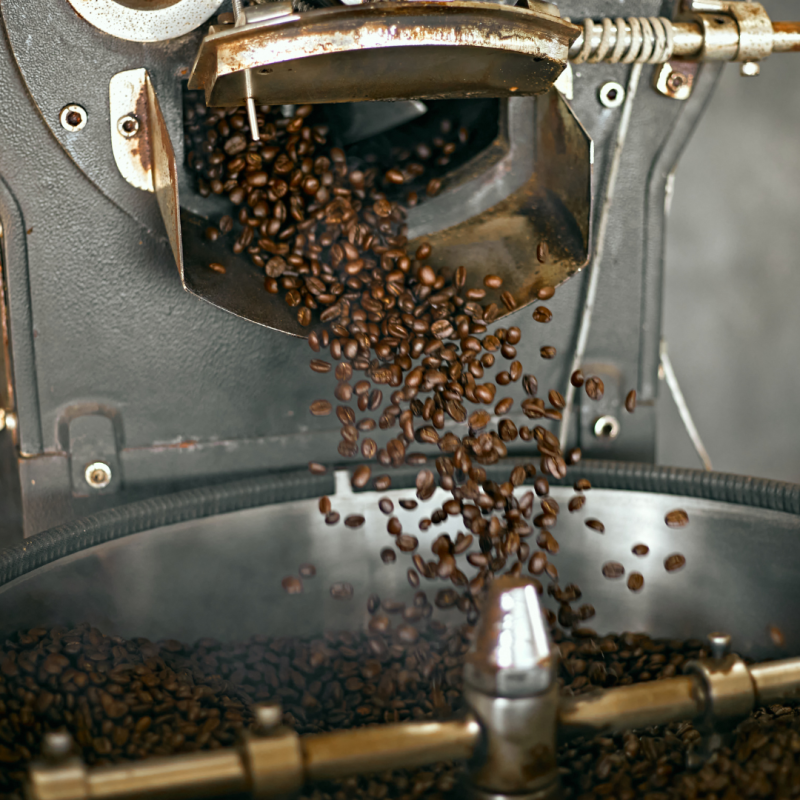
Everyone talks about the flame. Nobody talks about the second after. Yet cooling coffee beans after roasting matters as much as the fire — and, for us, it's the only step in the whole process we don't do with our own hands. The wind does it.
When Golden pulls the batch off the flame, the beans are still alive inside. They keep roasting on their own heat. If they don't drop below 40°C in under four minutes, the taste "bakes": the sweetness fades, the aroma dies, the cup goes flat. Indoor roasteries solve this with a tray and a fan that pulls air through the beans. Simple. Constant. Enclosed.
Why cooling coffee beans after roasting in the open air is like nothing else
At the Marché de l'Abattoir we have no fan. We have the sky. When Golden pours the scorching beans into the wide tray, the Brussels air rushes over them — and that air is never the same. On Saturday it blows from the northwest, cutting, at 40 km/h across a day climbing toward 34°C. The wind becomes the fan no one can buy: it tears the heat out of the beans in the middle of the heatwave. On Sunday the air is cooler and heavier, cloudy, a shower on the horizon — the cooling comes gentler, slower, other.
Same bean, same sack, two different weekends — two different temperature drops. The sky doesn't just roast the batch. It stops it too. It signs twice.
What we don't do: quenching
There's an old shortcut: spray the beans with water to cool them faster. It's called quenching, and the specialty world let it go long ago — it leaves a flat, metallic, leathery taste. We never put water on a batch. We let the cool air do the work, the way it always has. Slower than a jet of water, but honest. Raw.
The wind as the last ingredient
A fan always pulls the same air, at the same speed. The wind doesn't. It accelerates, stalls, turns. A strong gust closes the bean's pores fast and traps the aromas inside. A lazy breeze grants a few extra seconds, a trace of heat that rounds things off. We don't control this. We read it. Every batch keeps, in the speed at which it cooled, the signature of that Saturday's weather.
That's why a Meteo Koffie batch can't be reproduced. Not because we don't want to — because it isn't possible. This weekend's sky will never return. The air that cooled the beans today was that air only once.
What cooling coffee beans after roasting leaves in the cup
A batch cooled fast in a cutting wind holds its acidity and sweetness tight — vivid, precise, sharply drawn. A batch cooled more gently in heavy summer air settles rounder, warmer, more forgiving. Neither better nor worse. Other. It's that day, caught in the bean.
Come see the last act with your own eyes. We roast and cool in the open air on Saturday and Sunday at the Marché de l'Abattoir, by the exit of the Manufakture car park, Anderlecht. When Golden pours the beans into the tray and the wind dives over them — that's the moment. Small batches go fast; those who know, know: meteokoffie.com.
Brut. Sauvage. Imprévisible.
Internal links:
---
