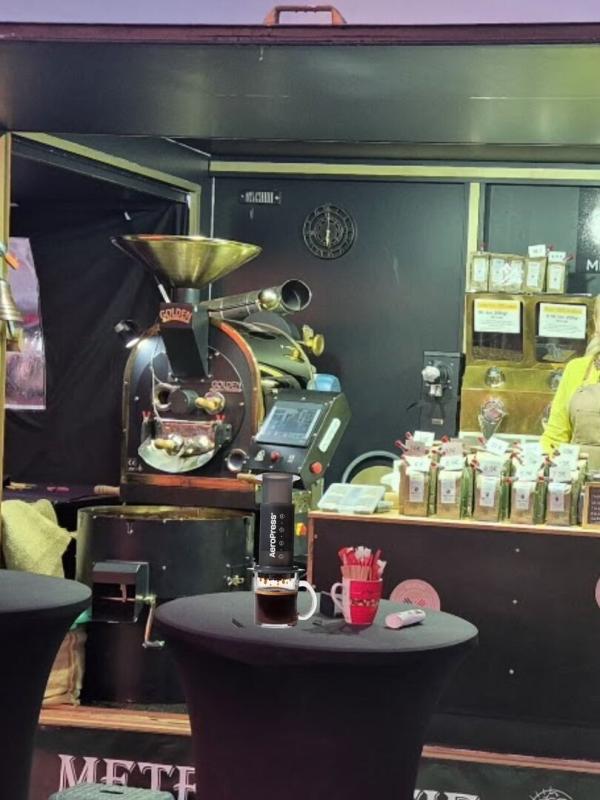
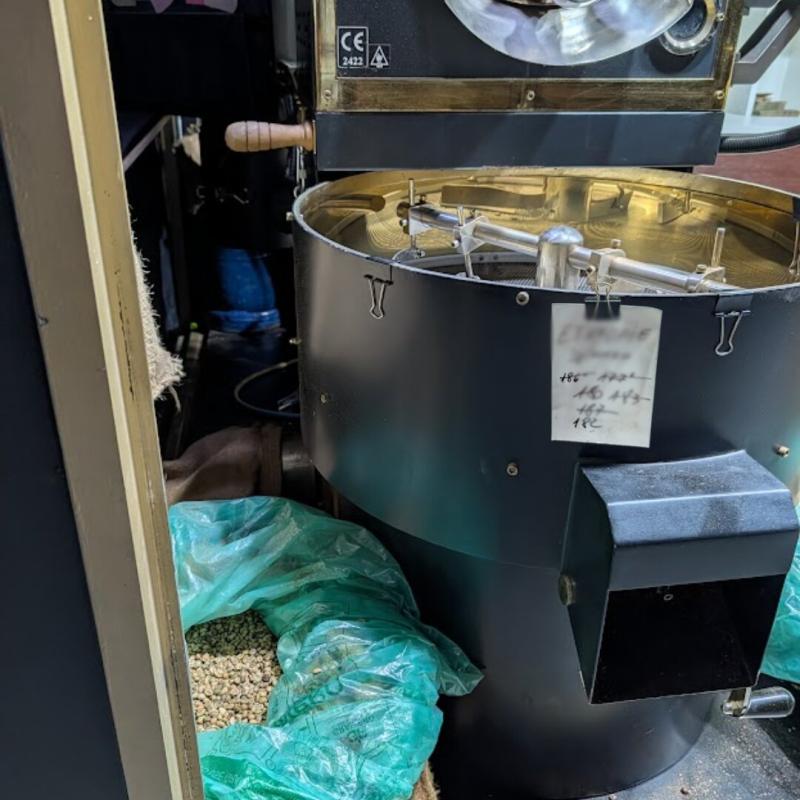
The sack arrived this week and the jute says liberica. It is a species half the people who walk past the stall have never tasted. Liberica coffee roasted in the open air at Marché de l'Abattoir starts exactly like this, with a batch Laurent knows only from the label so far: origin, processing, altitude. The rest we learn on Saturday morning, when Golden warms up and the first beans go into the drum.
Why liberica coffee roasted in the open air starts from zero
Laurent has carried plenty of jute sacks to this stall and not one of them said liberica. Out of more than 120 Coffea species, world trade rests on two, arabica and robusta, and liberica stays under one percent of what the planet drinks. A small roaster can work for ten years without a single sack of it passing through their hands. That is why this one sits beside the drum in plain view: it is the first one for which our folder of roast sheets is empty. The label gives us the processing, and processing is exactly what pushed the species into the specialty conversation this year. Anaerobically fermented lots come out with tropical fruit and a syrupy body, washed lots lean floral and citric.
This sack came through Antwerp, the largest green coffee port in the world, where the bean waits in warehouses with temperature and humidity held steady all year. Three days later it comes out onto concrete, at a market stall, under a sky that changes its mind every hour. Everything this roastery does at the market sits between those two places.
How liberica coffee roasted in the open air behaves in the drum
The first check happens with a hand in the sack, before anything gets set. A liberica bean fills the palm differently: it runs 50 to 75% larger than an arabica bean and reaches 12 to 16 millimetres, with an irregular shape and uneven density. Heat travels into it at several speeds, so one single bean can come out pale on one face and dark on the other. It needs longer development, and a short curve leaves a green, grassy taste in the cup.
This weekend gives us two different days. Saturday between 13 and 22 degrees, overcast in the morning and clearing after midday, dry, a light south-westerly under 10 km/h, air that almost stands still beside the drum. Sunday overcast from morning to evening, two degrees cooler at midday, the same south-westerly blowing three times harder from first light, around 15 km/h, with a chance of drizzle in the afternoon. Laurent reads that gap before he lights the burner, then adjusts the fire and the timing on Golden. On a bean this size, the margin is counted in tens of seconds.
The first test roast: liberica coffee roasted in the open air, in front of customers
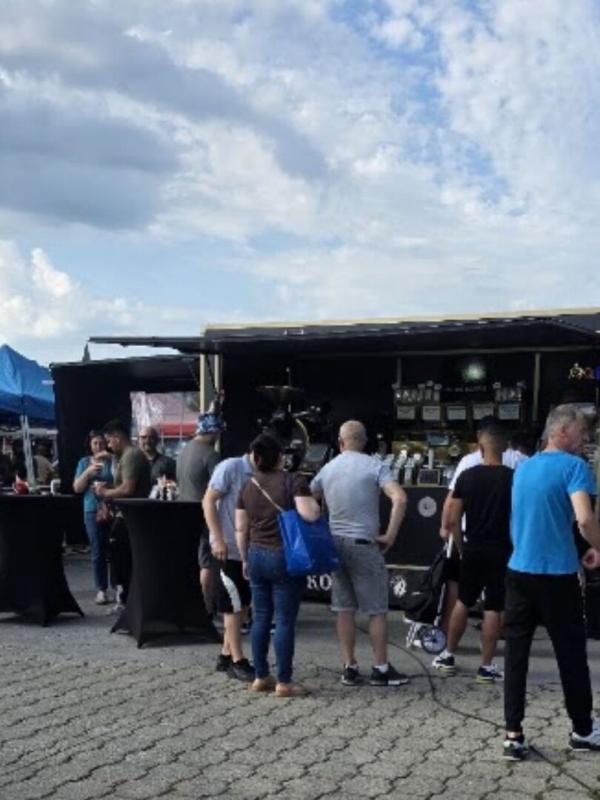
Large roasteries have a room at the back where they can make mistakes quietly. We have a drum out in the open, in the middle of the market, with people stopping to ask what that smell is.
Laurent asks the bell for permission, then listens. With liberica, first crack arrives later and spreads across tens of seconds, because the beans are not the same calibre and do not get there together. He writes on a piece of cardboard: flame position, the minute, the smell in the smoke. If the first attempt is wrong, it goes into the bucket with everyone watching. That is the honest part of this trade, and it is also the part that makes your hands sweat.
What Libex means for liberica coffee roasted in the open air
On 14 May 2026, Aaron Davis and his team at the Royal Botanic Gardens, Kew published an analysis of 113 samples from three continents in Scientific Reports and proposed the name Coffea × libex for the hybrid between liberica and excelsa. Farmers in Sarawak had been growing it for years without knowing what they had in their hands.
For a small roaster, the part that counts is felt in the palm. The study shows the hybrids landing between both parents on seed size and parchment thickness, two things that weigh heavily at harvest and in processing. For whoever stands at the lever, they decide how far the settings move from one lot to the next. The study also credits them with carrying disease resistance across. The translation for us is simple. Over the next few years, more sacks will arrive with no roast sheet written by anyone else.
This is exactly the trade we chose. A closed workshop asks its supplier for a ready-made profile and replays it on a screen. At the stall in Anderlecht, the first profile of an unknown batch gets written by hand, on cardboard, on a Saturday morning, with that day's air in it and ten people watching over a shoulder. Whoever buys the bag also takes home the very first note ever written about that bean.
Where to taste liberica coffee roasted in the open air
The test batch comes out on Saturday and Sunday, at Marché de l'Abattoir, by the exit of the Manufakture car park in Anderlecht. Ask for the tasting cup and tell Laurent what you find, because the notes on that cardboard are also written from what people say after the first sip in the open air. The quantity is small and this batch will never repeat identically. If you want a rare lot without having to choose, take the Meteo Discovery Box. The rest of the lots are here.
Brut. Sauvage. Imprévisible.
---