
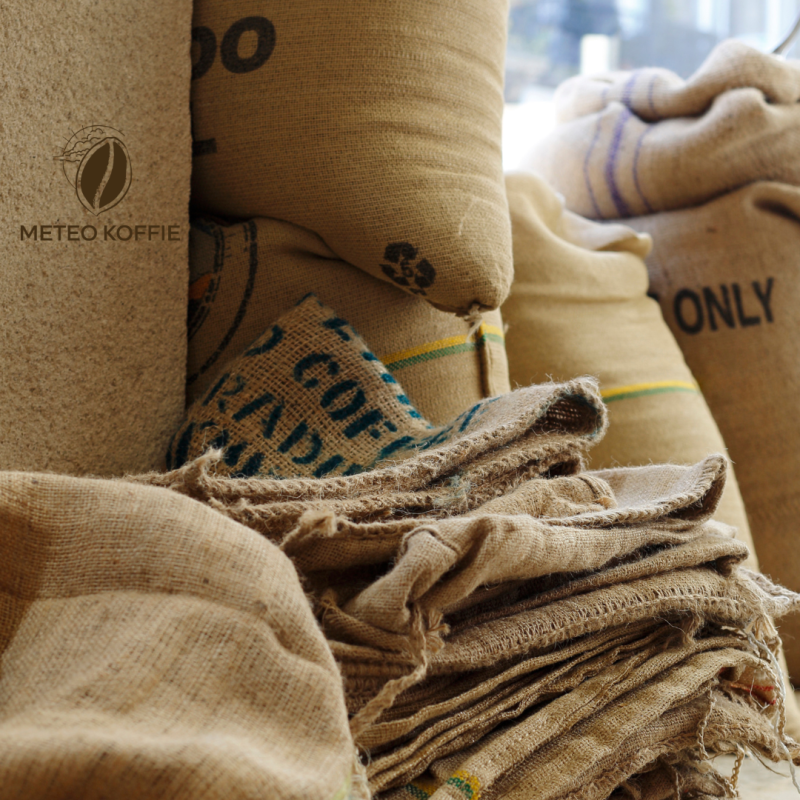
Before it's coffee, it's a coffee jute sack. A coarse cloth, hand-stitched at the other end of the world, filled with green beans and pushed out onto the water. By the time it reaches the Marché de l'Abattoir, at the exit of the Manufakture parking in Anderlecht, that sack has seen more countries than all of us put together. We don't hide it. It stays outside, next to Golden, mouth open, in the wind.
The coffee jute sack: the first vessel of the batch
Green coffee doesn't travel in plastic. It travels in jute because jute breathes. The fibre lets air pass through, keeps moisture at bay, and stops mould from taking hold on the long crossing. A coffee jute sack isn't packaging — it's a lung. The beans sleep in it for months, breathing the air of the seas, before the fire ever touches them.
That's why we keep it in plain sight. It's one of our pillars: hot metal, concrete, jute. Everything raw, everything honest. Indoor roasteries receive jute too — but they open it sheltered, in a warehouse, and tidy it away before anyone arrives. With us, the sack is a character. You touch it. You smell the cloth. You see where the bean in your cup began — the same Colombian lot the Andes and the sky wrote together.
What an empty coffee jute sack smells of
An emptied jute sack doesn't fall silent. It smells of earth, of the road, of the forest the coffee came from. It's the map of a whole batch. And in 2026, now that sustainability is no longer a marketing angle but an assumed expectation (MTPak Coffee wrote in January about recycled sacks as the future of packaging), the question is no longer how do you throw the sack away, but who do you give it to.
Here, the market hands us a privilege no webshop has. An empty sack doesn't slide into a parcel. It passes from hand to hand. Someone takes it for the garden — jute holds weeds to the ground and composts down with nothing toxic. Someone else for the cellar, for firewood, for a corner of the workshop. Nothing good gets thrown away. The cloth that carried an ocean ends up bordering a square of soil.
The coffee jute sack that crosses twice
This weekend the market warms up — Saturday toward 30°C, Sunday milder, toward 24°C, with a light north-easterly. The jute will stand there, coarse and warm under the hand, while the bean gives in fast to the sun and lets go of bright notes. Every batch comes from a different sack, and every sack was an entirely different journey. The sack crosses the ocean full and comes back to the city empty, but not useless. It makes the second trip, the short one: from the market to a garden in Anderlecht. Not sure where to start? Take a look at the shop and pick your first lot.
Come Saturday or Sunday, to the Manufakture parking. Take the coffee. And if you have a garden — ask for the sack. Those who know, know: meteokoffie.com.
Brut. Sauvage. Imprévisible.
