
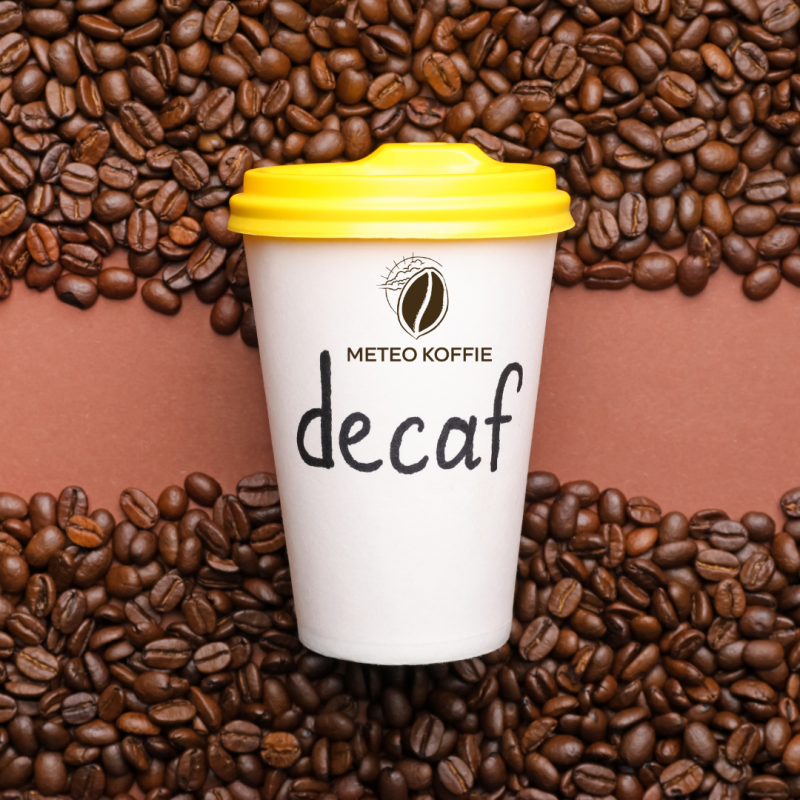
There is a bean that refuses to speak. It doesn't crack. It doesn't change colour honestly. It arrives at Golden already darker than it should be, tired from a process the others never went through. It's decaf. And decaf coffee roasted in the open air is the hardest exam a roaster can sit — because every one of his usual signposts goes silent.
Decaf coffee roasted in the open air: the bean that won't crack
To understand its difficulty, you have to know what happened to it first. The caffeine is drawn out of the still-damp green bean — at Meteo Koffie, with water (Swiss Water) or with sugarcane (EA), no harsh solvents. The bean comes out clean, but changed: its walls thinner, its structure softer, its green darker.
And that rewrites everything a roaster knows. The bean drinks the heat more greedily and reaches the end sooner — the window is shorter, the mistake nearer. The colour lies: it looks darker-roasted than it tastes. And the first crack — the sound every roast leans on — is dull in decaf, muffled, sometimes silent altogether. The bean that on other days shouts "now!" here only whispers, or nothing at all.
Decaf coffee roasted in the open air: the nose takes over
A closed workshop solves this with a probe and a curve. It freezes the variables, reads the temperature on a screen, calculates development time to the second. We have no wall and no screen. We have Saturday's north wind, 35 km/h, that steals the crack before the ear can catch it. We have 30 degrees and a moving sky. And we have Golden's nose.
Because when the ear fails, smell takes over. The trade itself says so: in decaf, the most reliable sign of first crack is the smell — a warm sweetness that rises at the precise instant the bean turns. Golden reads it in the air, bent over his metal drum, between flame and wind. Not a sensor. A man who sniffs. Where the caffeinated bean lets itself be heard, decaf lets itself be smelled.
It is roasting stripped of all its crutches. No probe, no trustworthy colour, no sound. What remains is the bare craft: roast, taste, adjust, taste again. Exactly how we like it.
Decaf coffee roasted in the open air: the evening coffee without stolen sleep
For a long time, decaf was everyone's punchline. Not anymore. In 2026, single-origin decaf lots reach specialty scores, and a decaf has already won a world brewing championship. The caffeine-free bean is no longer a concession — it's a choice.
And it has a meaning of its own. It's the coffee after dinner, the one that won't steal your night. The cup you can drink at nine in the evening, at the table, with your people, without tossing in bed until three. The whole ritual — the aroma, the hands around the cup, the moment — with everything you love about it, minus the sleeplessness. The same coffee roasted under the Brussels sky, only it lets you sleep.
This weekend's decaf lot is roasted like all the others: in the open air, at the Marché de l'Abattoir, by the Manufakture parking exit in Anderlecht, Saturday and Sunday. Saturday's sky is nervous and cloudy; Sunday clears. The silent bean will feel them both.
Come and see how you read a bean that refuses to speak. A few bags, roasted in plain sight. If you know, you know.
Brut. Sauvage. Imprévisible.
Internal links:
---
